
There's a label in the picture above that illustrates the problem better than any specification sheet could.
It's red. It's faded. The colour is rubbing away at the edges — and because the text is white, that means the text is going too. It was a safety instruction label for an SF6 gas leak procedure. Not a label you want becoming illegible.
This isn't a rare failure. It's what happens when the wrong material is specified for the job, or when cost wins the argument it shouldn't win. Understanding the difference between label materials — and what each one actually does in practice — is what this post is about.
The Case for Traffolyte
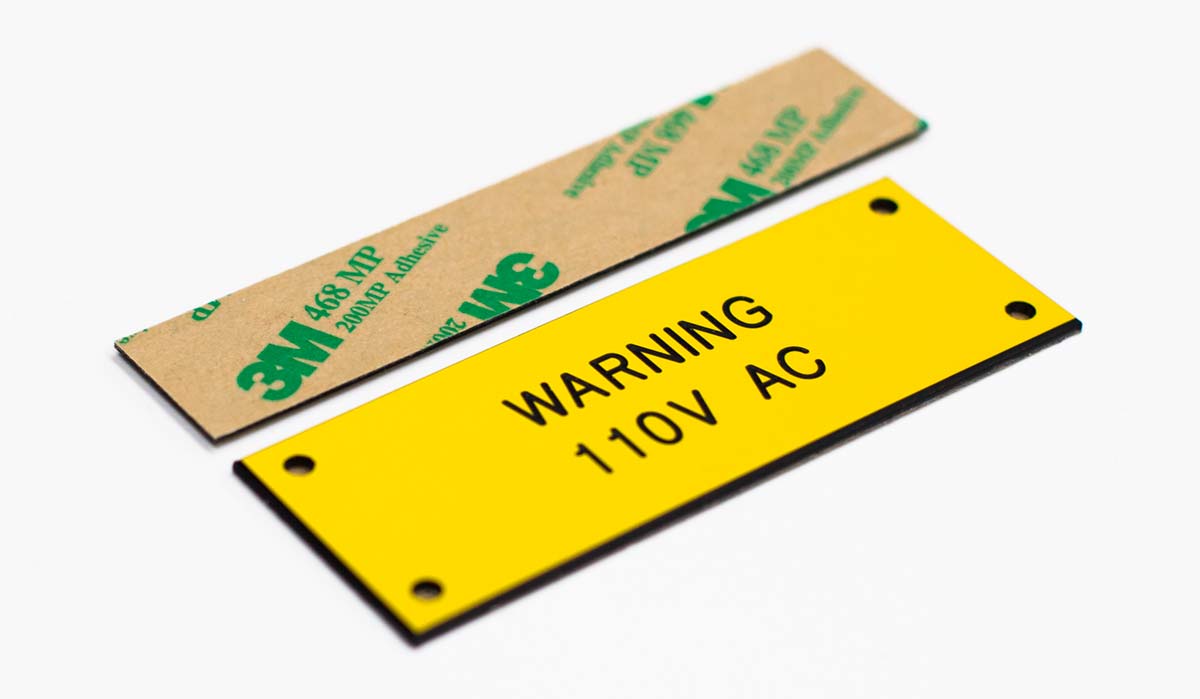
Traffolyte has been the default engraving material across UK electrical and industrial installations for close to a century, and for good reason. It's a phenolic laminate — hard, chemically resistant, electrically non-conductive, and dimensionally stable under the heat conditions found inside most enclosed panels.
The engraving process removes the top layer to reveal a contrasting colour core beneath. The text isn't printed on — it's physically part of the material. That's why a traffolyte label from the 1980s can still be legible today, even if it's lost some of its original condition.
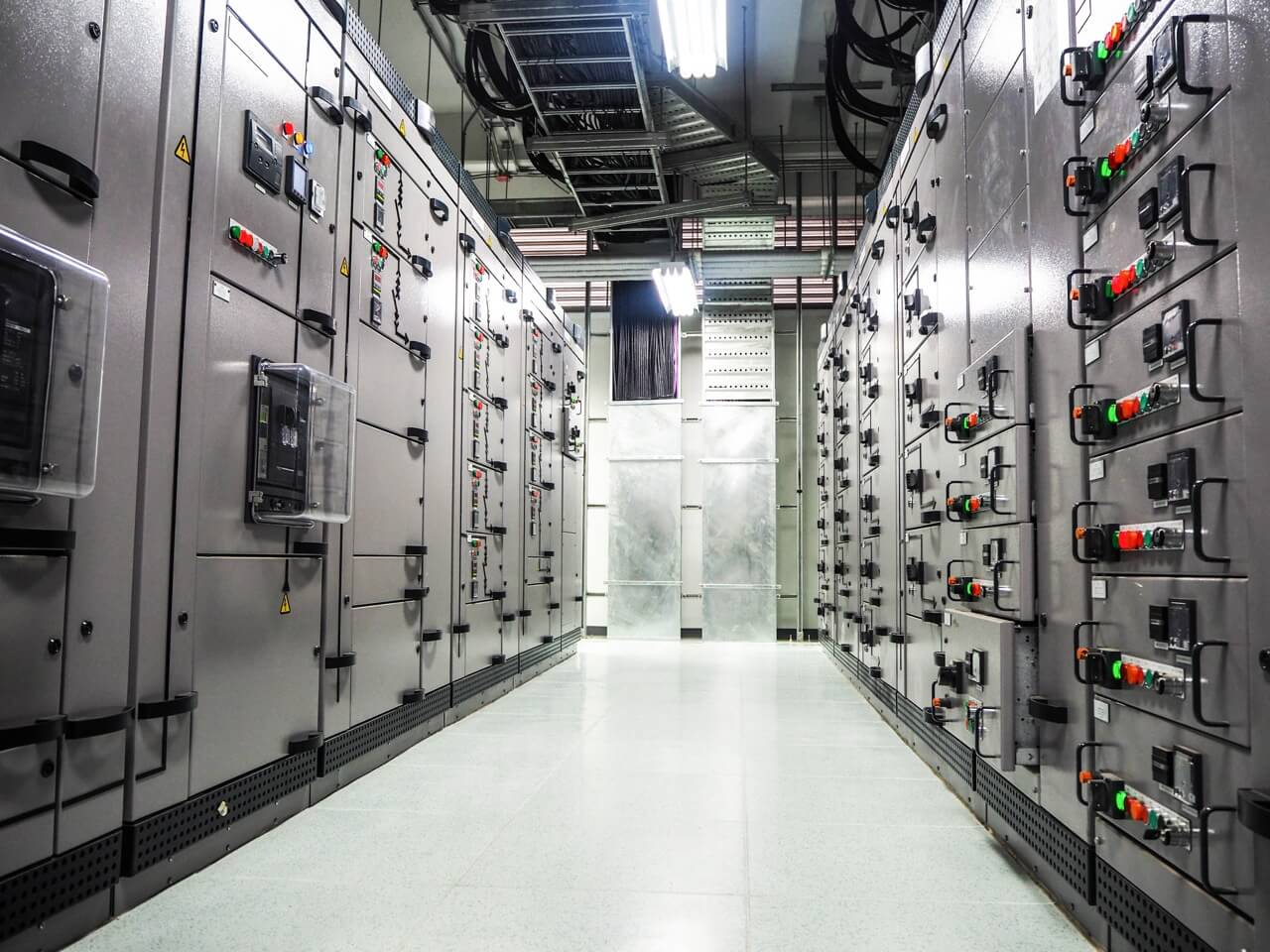
For applications where longevity and electrical insulation are the primary requirements — control panels, switchgear, valve tags — traffolyte remains a strong specification.
We supply it. And for many applications, it's exactly the right call.
Where Traffolyte Has Limitations
That said, traffolyte isn't without its constraints — and understanding them matters if you're specifying labels for a modern installation.
Laser engraving produces mixed results on traditional traffolyte. The top layer is relatively thick, which means laser engraving doesn't achieve the same crispness as it does on modern micro-laminates. The result can look coarser up close — which matters if you care about how your panel reflects your workmanship.
It can't be laser cut. Traditional traffolyte has to be cut with a saw or guillotine. That adds time to production, which is a meaningful factor when you're working to a tight installation schedule. It's one of the reasons lead times in this industry have historically stretched to six weeks or more.
Rotary engraving has its own visual limitations. Getting the cutter weight right for the text thickness is a judgement call, and when it's slightly off — too thin, and legibility suffers at distance; too thick, and the label looks dated. Font choice matters too. Older mechanically engraved traffolyte labels often look their age not because the material has failed, but because the engraving technique has moved on.
Traditional deep engraving can trap residue. In food manufacturing and cleanroom environments, the recessed text on traditionally engraved traffolyte creates crevices that can harbour contamination. That's a compliance problem, not just an aesthetic one.
What Modern Micro-Laminates Offer
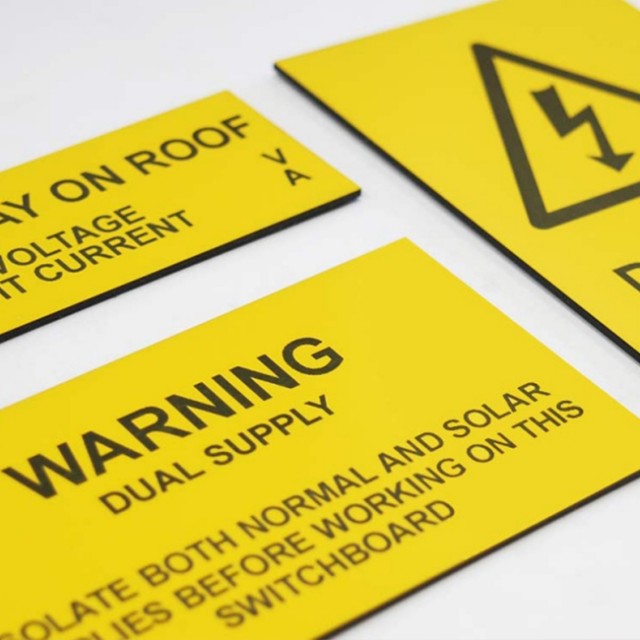
The alternative we reach for in many applications — and our standard material unless the specification calls otherwise — is an exterior-grade UV-stable 2-ply flexible laminate, laser engraved and laser cut.
The top layer is significantly thinner than traditional traffolyte. That produces sharper, crisper text from a distance — closer in appearance to a high-quality printed label, but with the permanence of engraving. It won't rub off. It won't fade in the way the red label above did.
Because it's laser cut rather than mechanically cut, production is faster. Labels with additional features — lamp holes, complex shapes, tight tolerances — don't add disproportionate time to the process. That's what brings lead times down to something that actually fits a project schedule.
Consistency is another advantage. Because the laser works from standard font files, text weight and character shape are identical across every label in a batch — and across batches produced months or years apart. If you need to add labels to an existing installation later, they'll match.
Which Material Is Right for Your Application?
There's no single answer, and anyone who tells you otherwise is simplifying the decision.
Traffolyte remains the right choice in applications where its specific properties matter most: electrical insulation, rigidity, chemical resistance in harsh environments, and installations where a deep-engraved label is explicitly specified or preferred.
Modern micro-laminates are often the better choice where production speed, visual quality, laser cutting, or food-safe hygiene requirements are priorities.
We work with both. The right conversation to have before ordering is about your environment, your installation timeline, and how long those labels need to perform — not just what material you've always specified.
If you want a thorough grounding in traffolyte specifically — what it is, how it's made, and when it's the right specification — our complete guide covers everything: The Complete Guide to Traffolyte Labels