What They Are, How They Work, and When to Use Them
In industrial environments, labels are rarely noticed… until they fail. When identification becomes unclear during maintenance, the consequences are rarely immediate. They’re cumulative. Isolation takes longer. Risk increases. Rework is introduced. And it usually happens years after installation, long after the engineer who commissioned the panel has moved on and no original documentation survives. Durable, legible identification is one of those things that only gets appreciated when it’s absent.
Traffolyte labels have been the standard choice across UK electrical and industrial installations for close to a century because they solve that problem structurally. The identification is engraved into the material rather than printed on top of it. It cannot peel, fade, or be wiped off. In environments where panels and equipment are expected to operate for 20, 30, or 40 years, that permanence matters in a way that cost-per-unit never fully captures.
This guide explains what traffolyte labels are, how they’re made, how they perform in practice, how they compare to the alternatives, and when they’re the right specification — and when they’re not.
What Are Traffolyte Labels?
Traffolyte labels are engraved identification plates made from layered phenolic laminate. The top surface layer is mechanically or laser engraved to reveal a contrasting core beneath, creating permanent recessed lettering that is structurally part of the material itself.
The name “traffolyte” originated as a brand name in 1927, when the material was first developed by Metropolitan-Vickers Electrical Ltd at their Trafford Park factory in Manchester. It was initially created for transformer labels — an application that demanded permanent, electrically safe identification in environments that would see decades of use. After the original business changed hands and the brand fell into disuse, “traffolyte” became the accepted generic term across the industry for this class of phenolic engraving laminate.
Today, the term covers a range of multi-layer engraving laminates produced by different manufacturers. The underlying material and engraving principle remain consistent: a hard, thermoset laminate with a contrasting colour core, designed to be permanently engraved and to remain legible throughout the lifetime of the installation it serves.
Why the name matters
Specifiers sometimes encounter the material listed as ‘traffolite’, ‘traff’, ‘ABET rigid laminate’, or ‘hard laminate’. These all refer to the same class of material. If you’re specifying for a project that calls for ‘traffolyte’, any phenolic engraving laminate of equivalent specification should meet the requirement.
How Traffolyte Labels Work
The performance of a traffolyte label is a direct consequence of its structure. Understanding how it’s made is the most straightforward way to understand why it behaves the way it does.
A standard traffolyte sheet consists of three functional layers:
- Surface cap layer: The top layer, in the chosen background colour. This is what gets engraved.
- Contrasting core layer: The middle layer, in a different colour. This is what becomes visible once the cap is removed by engraving.
- Rigid thermoset base: The structural layer beneath, providing rigidity and dimensional stability.
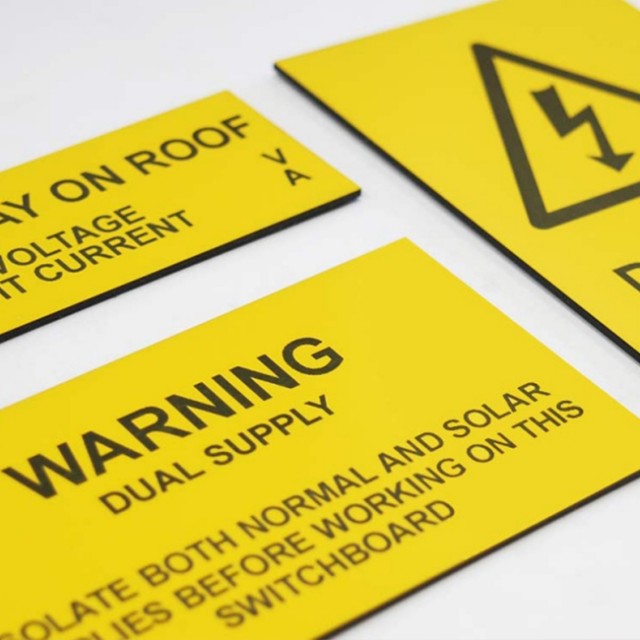
When engraved, the cap layer is precisely removed to the depth of the core, exposing the contrasting colour as the lettering. The result is text that is physically recessed into the material. It cannot be rubbed off because it isn’t applied to the surface — it is the surface, at a different depth.
This structural contrast is what defines traffolyte’s durability. A printed label relies on ink adhesion. An engraved traffolyte label relies on material contrast. Over the lifetime of a typical electrical installation, those are very different propositions.

What Is Traffolyte Made From?
Traffolyte is produced from layers of kraft paper impregnated with phenol-formaldehyde resin, compressed under heat and pressure to form a thermoset laminate. The phenolic resin gives the material its characteristic hardness and its excellent electrical insulation properties.
Because it is thermoset — meaning it cures into a fixed state under heat and pressure — it does not soften again under moderate heat once manufactured. This matters inside enclosed panels, where ambient temperatures can fluctuate significantly depending on load, ventilation, and ambient conditions.
Key material characteristics include:
- Electrical insulation: Zero conductivity. Safe for use directly on switchgear, busbars, and live panel components. Learn more here: Why Traffolyte Labels Don't Conduct Electricity - And Why That Matters
- Chemical resistance: Insoluble in water and most light industrial solvents. Resistant to acids and alkalis at normal concentrations.
- Dimensional stability: Does not expand or contract significantly with temperature changes under normal operating conditions.
- UV stability: Resistant to UV degradation, making it suitable for installations with exposure to natural or artificial light.
- Flame classification: Classified as Class 2 under BS 476 Part 7, meaning it retards rather than propagates flame spread.
- Odourless and chemically inert: Does not off-gas or migrate substances once cured, making it suitable for food production and healthcare environments.
It is worth noting that modern micro-laminate equivalents — thinner, precision-engraved laminates — offer additional benefits in food manufacturing environments specifically. Unlike traditional deep-engraved traffolyte, the shallower engraving depth of micro-laminates leaves no crevices to trap residue, which matters under environmental health requirements.
Traffolyte Colour Options
Standard traffolyte is available in a range of two-colour combinations, with the first colour being the background (cap layer) and the second being the engraved text (core layer). Specifying the right combination isn’t just aesthetic — in many industrial and electrical applications, colour conventions are established practice.
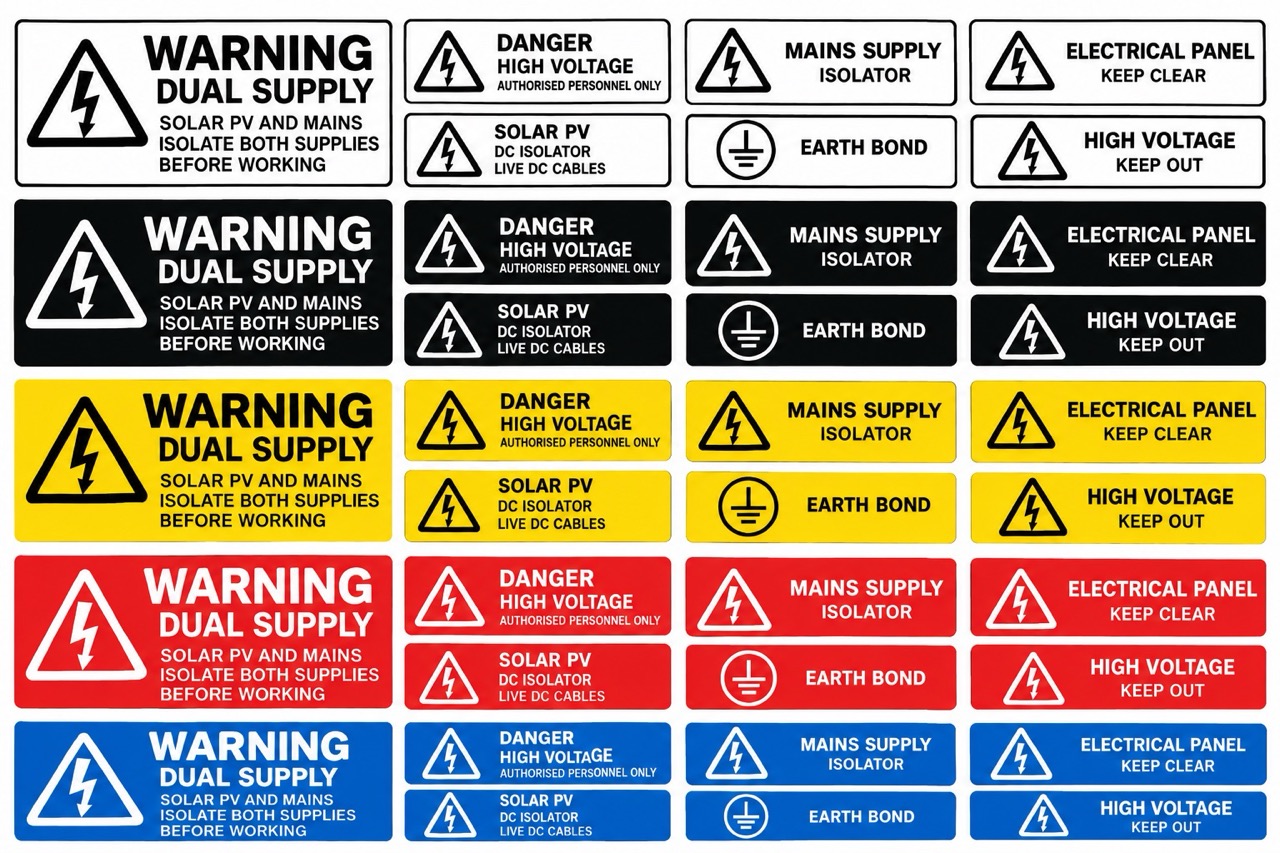
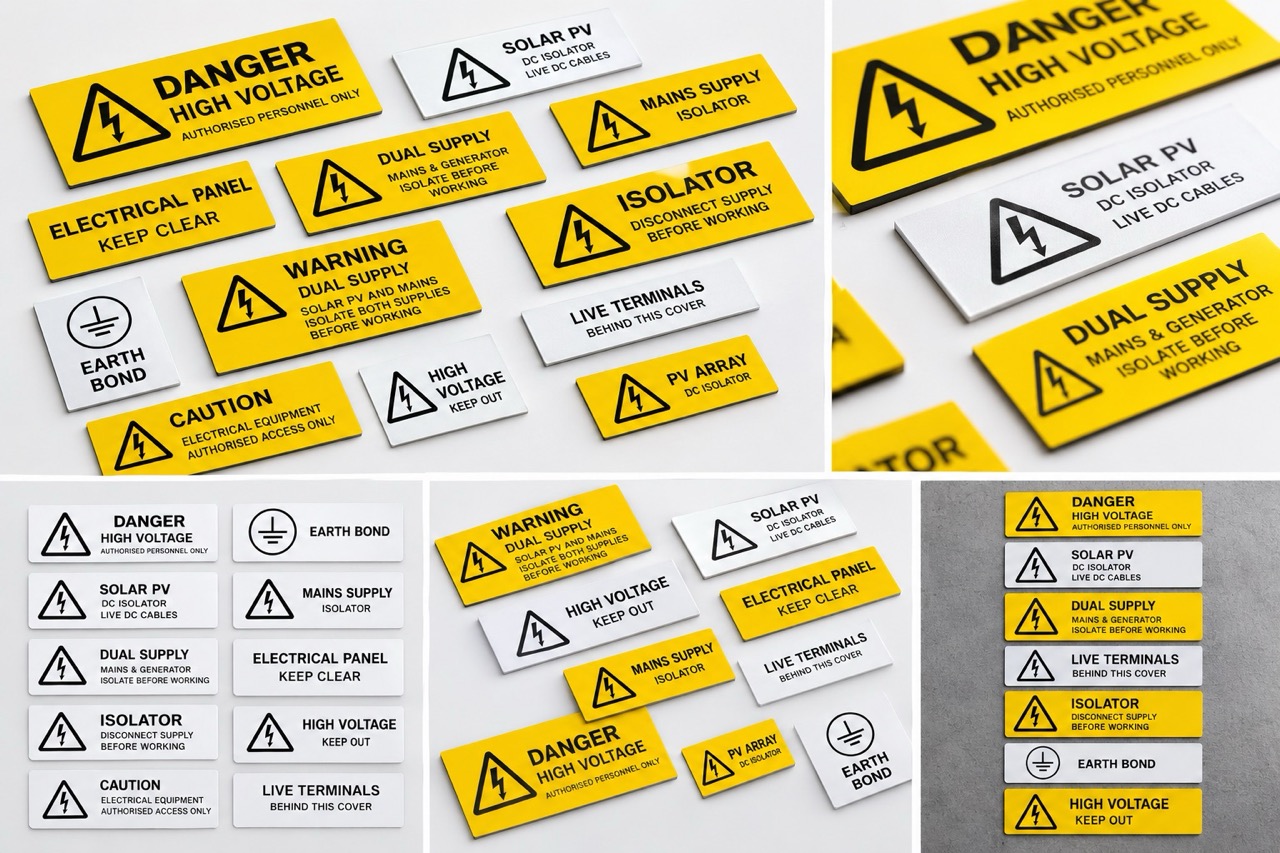
For most control panel labelling, black/white or white/black are sufficient. For safety signage, following ISO 7010 colour conventions ensures compliance and immediate recognition — maintenance personnel on unfamiliar sites expect hazard labels to be yellow and mandatory labels to be blue.
Laser Engraving vs Rotary Engraving on Traffolyte
Traffolyte can be engraved using two methods: laser engraving and rotary (CNC) engraving. Each produces a slightly different result and is suited to different requirements.
Laser Engraving
Laser engraving uses a focused beam to ablate the cap layer with high precision. The result is clean, consistent contrast with sharp edges even at small character heights. For modern panel labelling, laser engraving is the dominant method: it handles large batches with consistent repeatability, supports fine detail and small font sizes, and produces a finish that is indistinguishable from label to label across a run of hundreds.
Rotary Engraving
Rotary engraving uses a physical cutting tool to remove the cap layer. The cuts tend to be slightly deeper, which can be advantageous for thicker plates where additional engraving depth is specified. It remains the preferred method for certain traditional applications and for engravers working with thicker three-ply material where the deeper cut enhances legibility.
For the majority of electrical panel and industrial labelling applications, laser engraving is now standard. The consistency across large batches is particularly valuable when producing label schedules for distribution boards or valve tag sets where uniformity is expected.
It is worth being honest about the limitations of each method on traditional traffolyte. The cap layer on standard three-ply material is relatively thick, and laser engraving through it does not achieve quite the same crispness it produces on thinner modern laminates. Up close, the result can look slightly coarser. Traditional traffolyte also cannot be laser cut. Sheets must be cut mechanically with a saw or guillotine, which adds production time and is one reason lead times in this industry have historically stretched to six weeks or more.
Rotary engraving carries its own judgement calls. Cutter weight has to be matched to character height, and a slightly wrong choice either thins the text to the point of poor legibility at distance or thickens it into something that looks dated. Many older mechanically engraved labels look their age not because the material has failed but because engraving technique and font choices have moved on. A well specified label produced today should not repeat those habits.
Traffolyte vs Other Engraved Label Materials
Traffolyte is not the only option for engraved industrial labels. Acrylic, aluminium, and stainless steel are all used in industrial identification applications, and each has a different performance profile. Understanding the differences helps avoid under- or over-specifying.
The key differentiator for traffolyte in electrical applications is the combination of electrical insulation and engraving performance. Aluminium and stainless steel offer superior heat resistance, but they are conductive — which makes them inappropriate inside live panels and on switchgear where the label could become a contact risk.
Acrylic offers reasonable engraving performance and a wider colour range, but it lacks the rigidity, chemical resistance, and especially the electrical insulation properties of phenolic laminate. It is a legitimate choice for lower-exposure signage applications, but not for long-term panel identification in demanding environments.
Material choice should be driven by the environment and the expected service life — not by familiarity or cost alone.
Traffolyte vs Printed Labels
The comparison between engraved and printed labels comes down to a structural difference in how identification is applied.
Printed labels — whether self-adhesive vinyl or heat-shrink cable markers — apply identification to the surface of the material. The ink or print layer sits on top, held by adhesive or the substrate itself. Over time, in industrial conditions, that surface layer degrades: UV exposure fades the print, cleaning chemicals attack the adhesive, abrasion wears the surface, and temperature cycling causes delamination.
Engraved traffolyte labels carry the identification within the material. There is no surface layer to degrade because the lettering is the exposed core of the laminate itself. In applications where panels and equipment are expected to remain in service for decades, that structural difference has a practical consequence: printed labels will need replacing. Engraved labels typically will not.
That said, printed labels are not always the wrong choice. In applications where identification changes frequently, where installations are temporary, or where exposure to environmental stress is minimal, the flexibility and lower unit cost of printed labels may be entirely appropriate. The question to ask is not “which is cheaper to buy?” but “what is the total cost of this identification over the lifetime of the installation?”
Relabelling a populated distribution board years after commissioning is rarely straightforward. Circuits are live, access is restricted, and the original label schedule may no longer exist. Specifying durable identification at the outset is significantly less expensive than correcting it later.
Traffolyte vs Modern Micro-Laminates
[IMAGE: faded red SF6 procedure label from the original article. Alt text: Faded red printed safety label with white text wearing away at the edges, showing why engraved identification outlasts printed alternatives]
The label in the photo above was a safety instruction for an SF6 gas leak procedure. It is red, faded, and the colour is rubbing away at the edges. Because the text is white, the text is going with it. That is not a label anyone wants becoming illegible, and it is what happens when the wrong material is specified or when cost wins an argument it should not win.
Failures like that one are the reason engraved identification exists. But engraved no longer means only traditional traffolyte. Modern micro-laminates, typically exterior-grade UV-stable two-ply flexible laminates, are engraved and cut by laser, and in many applications they are now the standard specification unless the project calls otherwise.
The practical differences come down to the top layer and the cutting method. A micro-laminate cap layer is significantly thinner than traditional traffolyte, so laser engraving produces sharper, crisper text. The finish is closer in appearance to a high quality printed label while keeping the permanence of engraving. It will not rub off and it will not fade the way the red label above did.
Laser cutting also changes production economics. Labels with lamp holes, complex shapes, or tight tolerances add very little time to a laser-cut run, which brings lead times down to something that fits a real installation schedule. And because the laser works from standard font files, text weight and character shape are identical across every label in a batch, and across batches produced months or years apart. Adding matching labels to an existing installation later stops being a problem.
None of this makes traditional traffolyte obsolete. It remains the right specification where deep engraving is explicitly required, where maximum rigidity matters, or where a project standard calls for it by name. The two materials are complementary rather than competing. The right conversation to have before ordering is about your environment, your installation timeline, and how long the labels need to perform, not just what material has always been specified.
Where Traffolyte Labels Are Used
Traffolyte has become the default identification material across a wide range of UK industrial and electrical applications, largely because its combination of durability, insulation, and legibility suits environments where labels are expected to outlast the people who installed them.
Electrical Control Panels and Distribution Boards
This is the most common application. Traffolyte labels identify circuit breakers, isolators, contactors, busbars, and terminal blocks on control panels and distribution boards. The non-conductive properties are essential: labels are frequently positioned adjacent to live components, and any conductive material presents a contact risk. Panels are also cleaned, inspected, and worked on throughout their service life — labels need to remain legible across decades of maintenance cycles.
Switchgear
Permanent identification on switchgear — particularly in substations, motor control centres, and industrial distribution networks — follows the same requirements as panel labelling. Labels must remain legible throughout the equipment’s operational life, resist infrequent but rigorous cleaning, and carry no conductivity risk.
Valve Tags and Plant Infrastructure
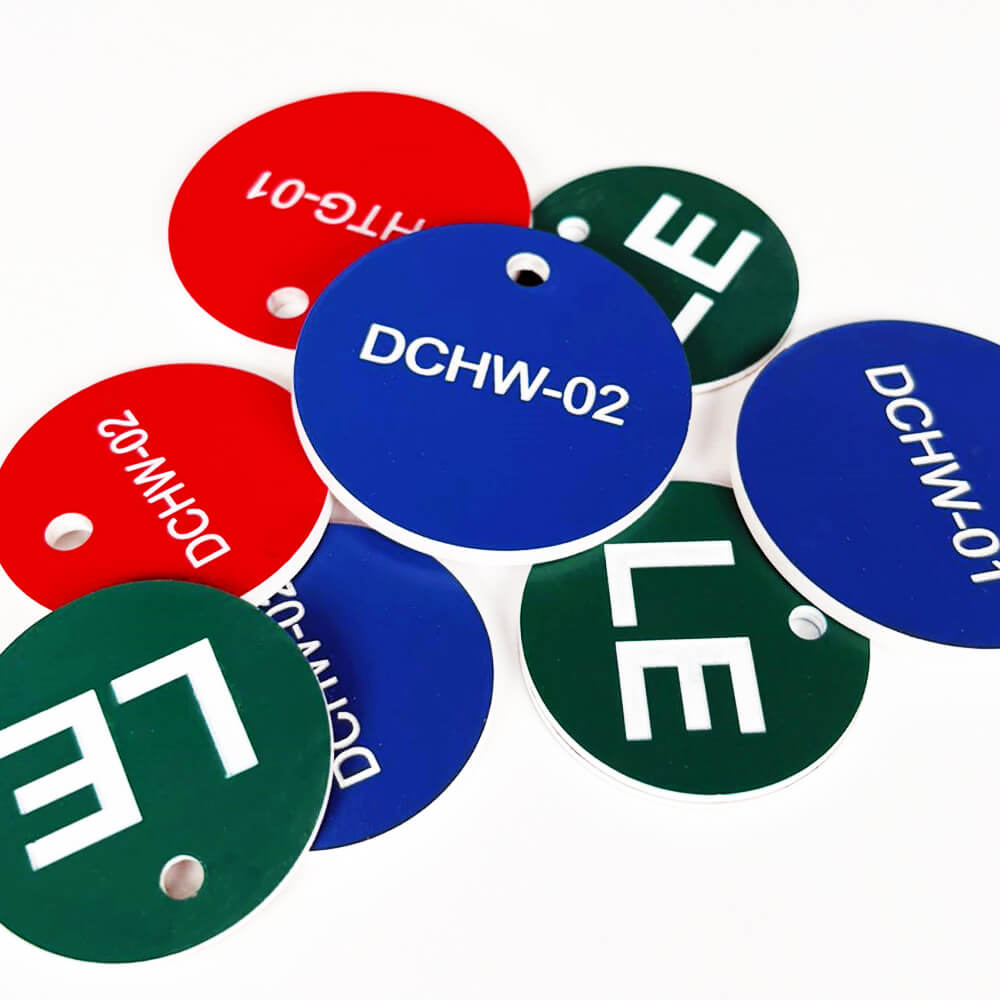
Plant rooms, boiler houses, pipework systems, and process equipment require identification that survives the combination of heat, humidity, cleaning chemicals, and physical contact from maintenance personnel. Traffolyte valve tags are typically 50mm diameter discs, pre-drilled or slotted, mounted on cable ties, wire, or ball chains. They provide permanent identification for isolation procedures and maintenance records that is resistant to the plant environment.
Data Centres and Comms Infrastructure
Patch panels, cable management systems, and network infrastructure require dense, precise identification in environments where legibility in low light matters and labels may be positioned in tight spaces. Engraved traffolyte labels for data centre applications typically use smaller character heights and tighter tolerances than industrial panel labels, but the same permanence argument applies: cabling infrastructure is expensive to re-label accurately once installed.
Food Manufacturing and Cleanroom Environments
Traffolyte’s chemical inertness and resistance to cleaning agents makes it suitable for food production environments, provided the correct laminate type is specified. Micro-laminate materials are particularly well-suited here: the shallow engraving depth means no crevices to trap food residue, which matters for environmental health compliance. The material does not absorb moisture and can be wiped down repeatedly without degradation.
Asset Tagging and Safety Signage
Beyond electrical applications, traffolyte is widely used for asset identification plates, equipment serial numbers, safety warning signs, mandatory instruction labels, and fire safety signage. Its durability makes it appropriate wherever a label is expected to remain in place, unchanged, for an extended period.
Environmental Exposure and Performance
Material selection for industrial labels should always start with a clear-eyed assessment of the environment the label will be installed in. Traffolyte performs well across most industrial conditions, but it is not universally superior in every environment.
Abrasion
Frequent wiping, cleaning, and tool contact are routine in industrial environments. Engraved laminate tolerates abrasion well because the identification is recessed below the surface. The cap layer may show surface wear over time, but this does not affect legibility as long as the engraving depth is sufficient and appropriate character heights have been specified.
Chemical Exposure
Traffolyte is insoluble in water and resistant to most light industrial cleaning agents and lubricants. Strong organic solvents — particularly ketones and aromatic hydrocarbons — should be assessed against the specific laminate specification before installation. In environments with aggressive chemical exposure, alternative materials may be more appropriate.
Heat
Phenolic laminate is dimensionally stable under the heat conditions found in most enclosed electrical panels. It does not soften or deform under normal operating temperatures. In extreme heat environments — furnace areas, engine compartments, high-temperature process plant — aluminium or stainless steel labels may be more appropriate.
Vibration
In plant environments with significant vibration, self-adhesive backed labels — of any material — can loosen over time. Mechanically fixed traffolyte labels (screwed, riveted, or cable-tied) are significantly more resistant to vibration-induced failure than adhesive-backed alternatives.
Outdoor Exposure
Traffolyte is UV stable and weather-resistant, making it suitable for outdoor installations. For extended outdoor exposure in harsh climates, or in coastal environments where salt spray is a factor, the specification should be discussed with the supplier to ensure the specific laminate is appropriate.
How Long Do Traffolyte Labels Last?
In indoor industrial environments, traffolyte labels routinely remain legible for 20 to 30 years. It is not unusual to find original traffolyte labelling still performing correctly on electrical infrastructure that has been in service for 40 years or more.
Longevity depends on several factors: environmental exposure, fixing method, character height, engraving depth, and installation quality. Labels fixed mechanically in controlled indoor environments typically outlast the equipment they’re identifying. Labels in harsh outdoor or chemically aggressive environments may show earlier degradation, depending on the specific conditions.
The more useful comparison for specifiers is not absolute service life but relative service life. Printed labels in the same environments will typically need replacing within 5 to 10 years — sometimes sooner. The cost of returning to site, accessing panels, and accurately relabelling populated equipment adds substantially to the total cost of a printed label over the lifetime of an installation.
Industry Standards and Compliance
Traffolyte itself is not defined by a compliance standard — it is a material, not a system. However, it is widely used within installations governed by UK and international standards, and its properties make it appropriate for that regulatory context.
Relevant standards that govern or influence label specification in UK electrical and industrial installations include:
- BS 7671 (IET Wiring Regulations): The UK standard for electrical installations requires that identification of circuits, conductors, and protective devices is durable and legible. Traffolyte labels satisfy this requirement in the vast majority of electrical installation contexts.
- ISO 7010: Defines safety sign colour conventions and symbols. Traffolyte safety signage specified to ISO 7010 colour standards — yellow/black for hazard, blue/white for mandatory, red/white for prohibition — ensures compliance and immediate recognition in multi-site or international contexts.
- BS 476 Part 7: Traffolyte is classified as Class 2 under this standard, meaning it retards flame spread. This is relevant for installations where fire performance of components is assessed.
- Machinery Directive / PUWER: The Provision and Use of Work Equipment Regulations and associated machinery safety frameworks require that controls and safety devices are clearly identified. Permanent engraved identification supports compliance more robustly than printed alternatives.
- LUL 1-085: Certain traffolyte label products have been tested and approved to London Underground’s specification for rail infrastructure identification. This is relevant for contractors working on LU and associated transport infrastructure projects.
Final specification must always be confirmed against the project requirements and the applicable standards. Traffolyte’s properties make it a strong default choice for most UK electrical and industrial applications, but specific projects — particularly those in regulated sectors such as rail, nuclear, or healthcare — may have additional or superseding requirements.
A Practical Specification Checklist
Most avoidable issues with traffolyte label orders arise from unclear schedules rather than material failure. Before ordering, confirm the following:
- Material thickness: 1.5mm is standard for most panel and equipment labels. 3mm is used where additional rigidity is required, or for larger labels where thinner material may flex.
- Colour combination: Confirm both background (cap) and text (core) colours. For safety signage, follow ISO 7010 conventions.
- Character height: Specify in millimetres. Smaller characters are legible at close range; larger characters are required where labels need to be read at a distance or in poorer lighting.
- Fixing method: Self-adhesive, screwed (specify hole positions and diameter), riveted, cable tie slot, or ball chain hole. Mechanical fixing is preferred for vibration-exposed or safety-critical applications.
- Label schedule accuracy: Check numbering sequences, circuit names, and any variable text carefully before submission. Label errors are difficult and time-consuming to correct once installed.
- Quantity and delivery: Confirm whether the order is a one-off batch or part of a phased project. Batch consistency matters for large label schedules — labels produced in the same run will match more precisely than those ordered separately over time.
Summary
Traffolyte labels have been a standard across UK electrical and industrial infrastructure since the late 1920s because their performance characteristics genuinely suit the demands of long-term industrial identification. Structural engraving, electrical insulation, chemical resistance, and dimensional stability are not incidental features — they are the reasons the material was developed and the reasons it remains in widespread use a century later.
It is not the cheapest option at the point of purchase. What it offers instead is a level of long-term predictability that printed and adhesive alternatives struggle to match in the environments where traffolyte is most commonly specified. In installations where identification must remain clear and safe for decades, that predictability continues to justify its use.
For applications where budget constraints are real, where installations are temporary, or where identification is expected to change — printed labels are a legitimate choice. The decision should always be driven by the requirements of the specific installation, not by habit or lowest unit cost.
Need traffolyte labels for your project?
Total Industrial Engraving has been producing engraved traffolyte labels for electrical contractors, panel builders, and facilities managers across the UK since 1996. Get in touch to discuss your requirements or request a quote.