Valve tags are one of those items nobody thinks about until they are missing. Then an engineer is stood in a plant room at two in the morning trying to work out which of eleven identical isolation valves feeds the line that needs shutting down, and the absence of a legible tag becomes a very expensive problem.
This guide covers what valve tags do, which materials suit which environments, how numbering systems work, where the relevant British Standards sit, and what information an engraver actually needs from you to produce a tag schedule. It is written for the people who specify and buy them: M&E contractors, facilities managers, water utilities, control panel builders and plant maintenance teams.
If you already know your spec and want materials, sizes and lead times, our valve tags and cable markers page covers the practical side.
What a valve tag actually does
A valve tag is a small engraved plate fixed to or near a valve, carrying a unique identifier and usually some combination of service, function and direction of operation. It ties a physical piece of hardware to a reference on a drawing, an asset register or a permit to work.
That link is the whole point. A valve on its own tells you almost nothing. A valve carrying tag CW-142 tells you it appears on the chilled water schematic, that maintenance history exists against it, and that an isolation procedure can name it unambiguously. Tags carry weight during commissioning, during planned maintenance, and most of all during incidents, when the people on site may not be the people who installed the system.
Tags also do quieter work. They speed up handover, because a tagged system can be walked and verified against drawings. They reduce the risk of the wrong valve being operated. They support compliance evidence during audits, particularly on water, food and pharmaceutical sites where identification of services is expected rather than optional.
Materials: what to specify and why
Material choice comes down to environment, expected service life and budget. Most UK sites end up with one of the following.
Engraving laminate (Rowmark and similar)
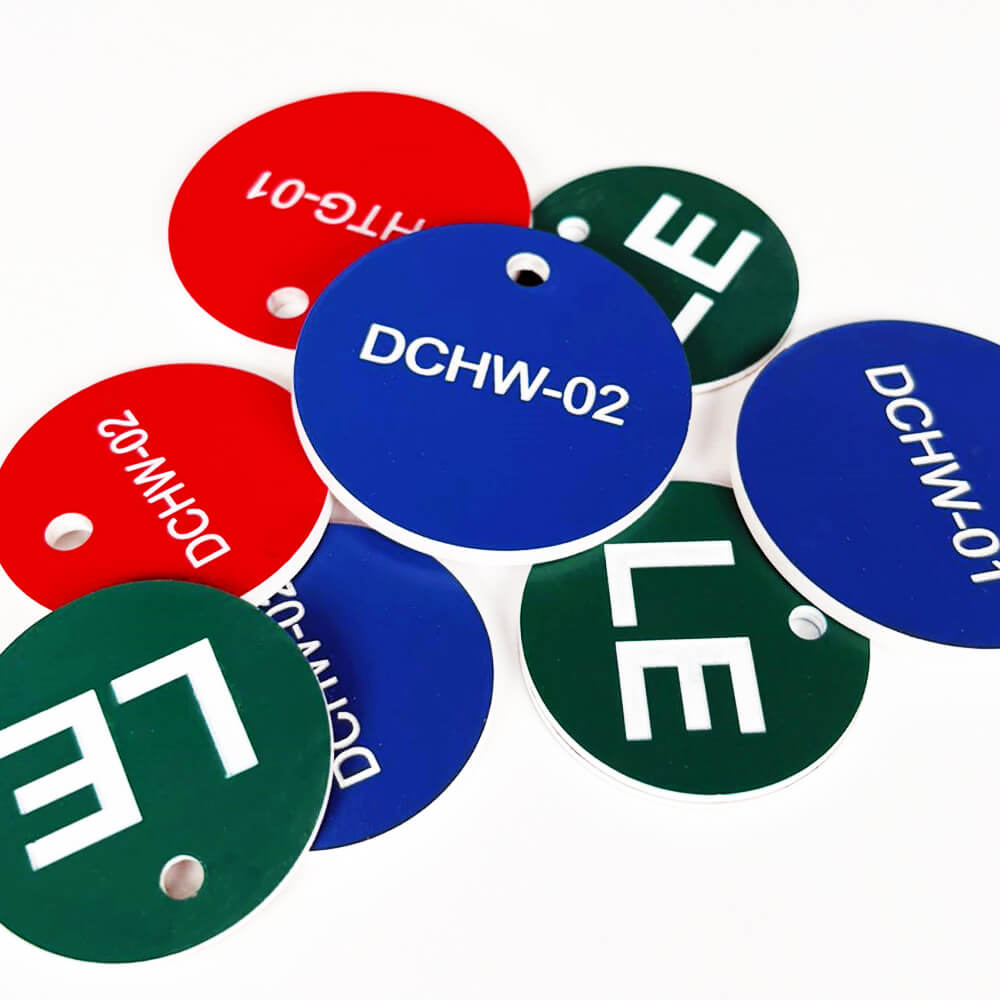
Two-ply engraving laminate is the standard choice for interior and sheltered exterior use. A coloured surface layer is engraved away to reveal a contrasting core, so the legend is part of the material rather than printed on it. It cannot rub off.
Modern laminates are UV stable, so they hold their colour outdoors far better than older materials. They are slightly flexible, which matters more than people expect: brittle tags crack when a chain swings against steelwork or when someone knocks one with a spanner. Standard stock is 1.6mm, with 3mm available across a wide colour range for situations where a heavier tag is preferred.
The commercial advantage is speed and cost. Laminate laser cuts cleanly, which means bespoke shapes and hole positions carry no tooling penalty, and turnaround is typically one working day on most orders.
Traffolyte
Traffolyte is the original engraving laminate and still specified by name across UK industry, often as a generic term for any engraved plastic label. It performs well in interior electrical and industrial environments and remains the standard on a great many panel and plant applications.
For valve tags specifically there are two limitations worth knowing. Traffolyte does not laser cut, so discs and complex shapes have to be machined, which adds time and cost. It also has lower UV stability than modern laminates, so exposed outdoor tags fade over long service life. For a full comparison of the material itself, see our guide to traffolyte labels.
Both materials have a place. Traffolyte remains the right answer for many interior applications and for sites standardising on an existing specification. Modern laminate is generally the better choice for discs, outdoor exposure and fast bespoke work.
Stainless steel
Where a tag needs to last indefinitely, stainless steel is the answer. 316 grade is the sensible default for UK industrial use, typically 0.9mm thick with a DP1 brushed finish. Laser marking produces a black legend that looks printed but is fused into the surface, so it resists chemicals, cleaning regimes and abrasion.
316 is worth specifying over 304 anywhere with chloride exposure, which covers coastal sites, water treatment, swimming pools and food processing washdown areas. The cost difference is small against the cost of retagging.
Avoid mirror polished tags. They look impressive on a sample board and become genuinely difficult to read on site, because direct sunlight or a torch beam reflects straight back at the reader. Brushed finishes stay legible from any angle and cost less.
Where black infill is not wanted, mechanical engraving produces a clean cut legend with no paint. For very fine detail or small text, chemical etching gives better definition than either.
Brass and aluminium
Brass is traditional, hard wearing and develops a patina that some clients prefer and others do not. It is common on heritage sites, in building services and anywhere an existing tag population is brass and consistency matters. Anodised aluminium sits between laminate and stainless on cost and durability, and is light enough for large tag counts.
For a direct comparison of the two most commonly specified metals, see our guide to brass versus stainless steel valve tags.
Fixing methods
The tag is only as good as its attachment. Ball chain is the most common fixing in UK industry, supplied with connectors and looped around the valve body or stem. It is quick, tolerant of odd geometry and easy to replace.
Stainless ball chain should be paired with stainless tags in wet or corrosive environments. There is no sense in specifying 316 tags and hanging them on a chain that will rust through in two years.
Alternatives include cable ties for temporary or low cost installations, S-hooks where tags need frequent removal, and stainless wire where vibration would work a chain loose. On valves with a flat accessible surface, direct fixing with screws or rivets removes the swing risk entirely, though it makes replacement harder.
Two holes rather than one stops a tag spinning, which matters when the legend needs to be read in a fixed orientation. It is a small specification detail that removes a recurring site annoyance.
Numbering and identification systems
There are three broad approaches, and the right one depends on what already exists on site.
Sequential numbering runs V-001 upward across the site or per plant room. It is simple to administer and easy to extend. It carries no information in itself, so it depends entirely on a register being maintained alongside it.
Service-prefixed numbering encodes the system into the tag: CHW-014 for chilled water, LTHW-022 for low temperature hot water, CWS-108 for cold water service. This is the most widely used approach in UK building services because it gives an engineer useful information before they reach for a drawing.
P&ID reference tagging mirrors the tag numbers already on the process and instrumentation diagrams. On process plant this is almost always the right choice, because it means the tag, the drawing and the asset register all use one identifier with no translation step.
Whichever system is used, the rules that matter are consistency and non-reuse. Do not recycle a number from a removed valve. Do not run two numbering conventions in parallel on one site. Decide the format before the first tag is ordered, because changing it later means retagging everything.
Our guide to valve tag numbering systems goes into the practical detail of building a scheme from scratch.
%20copy.jpg)
Standards and compliance
Valve tagging in the UK is shaped by a handful of standards, none of which mandate tag design in detail but all of which set expectations around identification.
BS 1710 covers identification of pipelines and services, defining the colour coding and marking conventions for pipe contents. Valve tags are commonly colour matched to the BS 1710 basic identification colour for the service they control, which gives an immediate visual link between valve and pipe.
BS 4800 defines the colour references used across construction, and is the source for the specific shades called up by BS 1710.
HSE guidance and the Safety Signs and Signals Regulations set the general duty around clear identification of plant and services, which is where the compliance case for tagging usually sits.
Sector specific requirements add to this. Water utilities work to their own asset marking conventions. Food and pharmaceutical sites need materials that survive cleaning chemistry and do not shed particles. Nuclear and rail carry their own approved materials lists.
The practical point is that colour coding tags to the service is low cost and high value. It costs nothing extra at the point of manufacture and pays back every time somebody walks the plant.
Sizes, shapes and engraving
Common UK valve tag sizes run from 25mm to 50mm diameter for discs, and 50 x 25mm up to 100 x 50mm for rectangular tags. The right size follows the legend, not the other way round: work out the longest line of text you need, set a minimum character height for the reading distance, then size the tag around it.
As a rule, 5mm character height is readable at arm's length and 10mm is readable across a plant room. Tags mounted high or behind guarding need larger text than the standard.
Shape is often used to code function. Round for isolation, rectangular for control, triangular for emergency or fire service. This is a site convention rather than a standard, but it works well and costs nothing where tags are laser cut, because bespoke shapes carry no tooling charge.
Engraving depth on laminate is set by the material thickness and is not usually a specification decision. On stainless, laser marking sits on the surface, mechanical engraving cuts into it, and chemical etching gives the finest detail. All three remain legible for the life of the tag.
Preparing a valve tag schedule
This is where most orders slow down, and it is entirely avoidable. An engraver needs the following to quote and produce accurately:
- Quantity, broken down by tag type where more than one is used
- Material and thickness
- Size and shape, with hole position and quantity
- The full legend for every tag, exactly as it should appear, line by line
- Colour, for both the tag and the legend
- Fixings, and whether these are being supplied
The legend list is the critical item. Supply it as a spreadsheet with one row per tag and one column per line of text. Not a PDF, not a marked up drawing, not a photograph of a handwritten list. A clean spreadsheet goes straight into the engraving software, which removes both the transcription delay and the risk of a typo entering the run.
Check the spelling before it goes out. An engraver will reproduce a schedule exactly as supplied, and a misspelt service name repeated across two hundred tags is an expensive lesson.
Ordering, lead times and repeat work
Laminate tags typically turn around in one working day on standard orders, which means a late change or an omission found during commissioning rarely delays a programme.
Stainless steel takes longer, usually around four working days for laser cutting, with express options available. Where a project timeline is tight, the cutting can often be scheduled while artwork is still being proofed, so the two run in parallel rather than in sequence.
For repeat and phased work, keep the schedule under version control on your side and reference the original order. A held schedule means top-up orders and replacements match the existing population exactly, with no drift in font, size or format across phases.
Proofs are worth the twenty minutes. Approve a PDF proof against your schedule before a production run starts, particularly on large orders or unusual legends.
Frequently asked questions
What are valve tags made from? Most UK valve tags are engraving laminate, traffolyte, stainless steel, brass or anodised aluminium. Laminate suits interior and sheltered use, 316 stainless suits corrosive and washdown environments, and brass is common in building services and on heritage sites.
What size should a valve tag be? Size follows the legend and the reading distance. Common sizes run from 25mm to 50mm discs and 50 x 25mm to 100 x 50mm rectangles. Allow 5mm character height for close reading and 10mm for reading across a plant room.
How are valve tags attached? Ball chain with connectors is the most common method, with cable ties, S-hooks, stainless wire and direct screw fixing used depending on environment and access. Match the fixing material to the tag material in wet or corrosive conditions.
Do valve tags need to meet a British Standard? There is no standard governing tag construction directly. BS 1710 covers identification of pipelines and services, and tags are commonly colour matched to it, with colours referenced from BS 4800.
What is the lead time on valve tags? Engraving laminate tags are typically one working day. Stainless steel is usually around four working days, with express options available.
Can valve tags be made in bespoke shapes? Yes. Laser cutting means bespoke shapes, sizes and hole positions carry no tooling cost, so discs, rectangles, triangles and rounded corner formats are all available without a price penalty.